
Why Twitter's fleets flopped
The uncanny valley of product development

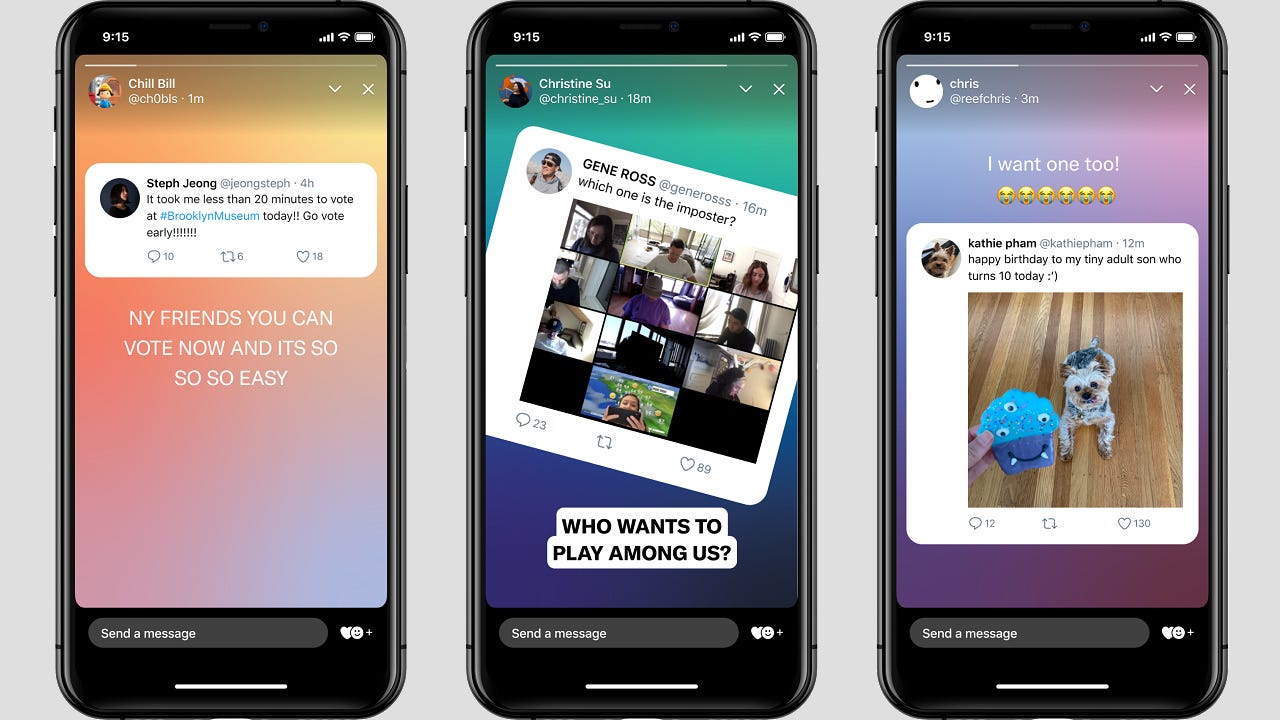
In November, after testing the feature in foreign markets for eight months, Twitter announced that Fleets — its version of the ephemeral stories that have colonized so many social apps since debuting in Snapchat — would become available worldwide. At the time, I was enthusiastic about the move:
Twitter enters the ephemeral posting game with some real advantages on its side. One, the format is familiar — if you’ve posted an Instagram story, you already know how to post a fleet. Two, the real-time nature of Twitter lends itself to documenting photos and videos in the moment — something fleets excel at. (Twitter never really cracked photo or video sharing; I suspect fleets will help it make inroads there.)
And three, tweets have always been best thought of as a mostly ephemeral format anyway. The old joke about Twitter is that it was where you would go to discuss what you had for breakfast. Now fleets are here, and there’s never been a better place to post your bowl of Cheerios.
As it turns out, though, I got most of this wrong. Less than a year after launch, Twitter said today that it would get rid of fleets on August 3. “We hoped Fleets would help more people feel comfortable joining the conversation on Twitter,” product manager Ilya Brown wrote in a blog post. “But, in the time since we introduced Fleets to everyone, we haven’t seen an increase in the number of new people joining the conversation with Fleets like we hoped.”
So why didn’t it work? Two things I mentioned in my first column on the subject did create hurdles for Twitter: fleets arrived late to an already crowded market, and they didn’t evolve fast enough to keep pace with creative tools on Instagram, TikTok, and other apps. (The generic, bolted-on visual appearance probably didn’t help either.)
But the real issue, I think, is in a point I listed as a strength in the excerpt above: tweets have always been best thought of as a mostly ephemeral format anyway. I believe that this, more than anything else, explains fleets’ demise.
Twitter originated not as a crowdsourced global news network but as a place to share status updates via text messages. They were modeled on the “away messages” that elder millennials once posted on AOL Instant Messenger before stepping away from their desks, updated for a world that had embraced mobile phones (but not yet invented smartphone apps.) Tweets, like away messages before them, were always meant to capture passing thoughts.
Fast forward to today, and Twitter now embraces a much wider variety of uses. Plenty of people write long-form essays over dozens of threaded posts, and people can “pin” a tweet to to highlight something that deserves a more prominent, permanent place in their profile.
But on a daily basis, Twitter is primarily a repository for the passing thought: an interesting link, a savage dunk, an awful pun or a dad joke. It is the promotional app of choice for anyone about to do something right now: go live on Twitch, start a Space, host a Zoom webinar.
Very few of these posts have any value beyond the first 24 hours in which they are tweeted. Only rarely on Twitter do you encounter a post older than a day; the vast majority of tweets are never seen again.
And so when fleets appeared at the top of the timeline last year, it’s understandable that the user base had no idea what to make of them. They were already using Twitter to post ephemeral thoughts, and those thoughts are called tweets. Fleets fell into a kind of uncanny valley of product development: they fulfilled a role too similar to tweets to serve a real need. Anything a person might have fleeted, they simply tweeted instead.
(It’s notable that the other big product Twitter launched in the past year, the live audio feature called Spaces, seems to be growing much more quickly: it’s different from tweets in an obvious way, but complements the core product such that it feels at home within the Twitter app.)
Ultimately, it speaks well of Twitter’s product organization that the company shut down fleets as quickly as it did. The company says it will bring some aspects of the product into tweets, including its camera, text formatting tools, and GIF stickers. The goal is still to get more people posting on Twitter — an act that still too often feels like screaming into a void, particularly for people who have just joined the service. “We’ll explore more ways to address what holds people back from participating on Twitter,” Brown said.
To me, one solution is obvious: given that tweets are ephemeral by nature for most users anyway, build that into the product. Tweets can still be permanent by default. But let users set their tweets to delete automatically after a day, a month, or a year. You don’t have to be a high-profile user to have seen the various ways in which people’s old tweets are used against them. Many have had their livelihoods derailed.
And yes, some of that accountability has been necessary and good. But I’d humbly suggest that most of us are better off living in a world where our every passing thought is not committed to a permanent, searchable global archive. Anyone who feels differently is on some level arguing for the construction of a panopticon, and I say the hell with that.
Ultimately, fleets were a worthwhile experiment in exploring what temporary posts could mean for Twitter. The lesson from the user base is that they view many, and perhaps most, of their posts as ephemeral already. If Twitter wants us to post more often, it should consider leaning into that.
The Ratio
Today in news that could affect public perception of the big tech companies.
⬆️ Trending up: TikTok now has more than 3 billion installs worldwide — the first non-Facebook app to do so. People love this app. And so does Facebook’s antitrust defense team! (SensorTower)
⬆️ Trending up: Facebook said it would pay out $1 billion to creators between now and the end of 2022. I’m extremely curious to learn more details here. (Taylor Lorenz / New York Times)
⬆️ Trending up: WhatsApp is testing multi-device support. Useful! (Richard Lawler / The Verge)
🔃 Trending sideways: A number of Twitch streamers are promoting gambling websites on their streams in ways that may violate US laws, experts say. A review “found that 64 of the top 1,000 most-trafficked Twitch streamers have streamed crypto slots or advertised sponsorship deals from crypto gambling websites.” (Cecilia D’Anastasio / Wired)
Governing
⭐ Facebook called for FTC chair Lina Khan to recuse herself from the government’s ongoing antitrust case due to her past writings critical of the company. However unlikely the move is to succeed, lawyers say the filing could improve Facebook’s odds if it has to appeal a decision. Here’s Brent Kendall at the Wall Street Journal:
“For the entirety of her professional career, Chair Khan has consistently and very publicly concluded that Facebook is guilty of violating the antitrust laws,” the company said Wednesday in a formal recusal petition filed with the FTC.
“When a new commissioner has already drawn factual and legal conclusions and deemed the target a lawbreaker, due process requires that individual to recuse herself,” Facebook said in the petition.
Hackers affiliated with the Russian government targeted European government officials with LinkedIn messages containing malicious links “designed to exploit unknown vulnerabilities in Windows and iOS,” according to a new report from Google. Finally, a good excuse not to check your LinkedIn messages. (Lorenzo Franceschi-Bicchierai / Vice)
Republican members of Congress are calling for an investigation of whether Amazon “unfairly used its influence” in seeking a now-scrapped $10 billion Pentagon contract. Kind of weird to suggest that Amazon had much clout during the Trump years, no? (Kenneth P. Vogel and Kate Conger / New York Times)
Twitter saw a marked increase in the number of government takedown requests targeted at journalists in the first half of 2021, according to its new transparency report. “India topped the list for information requests by governments in the second half of 2020, overtaking the United States for the first time.” (Sheila Dang and Elizabeth Culliford / Reuters)
About 1 in 5 adults in the United Kingdom has deleted the NHS’ COVID-19 exposure notification app, likely to avoid pressure to self-isolate. “More than a third of people aged between 18 and 34 years in the UK have deleted the app already, with about a third of those who do still have it expressing an intention to delete it in six days’ time.” (Kevin Rawlinson / Guardian)
Amid growing antitrust pressure, rival Chinese tech giants Tencent and Alibaba are considering opening up their services to one another. “Initial steps from Alibaba could include introducing Tencent’s WeChat Pay to Alibaba’s e-commerce marketplaces, Taobao and Tmall, some of the people said.” (Jing Yang and Keith Zhai / Wall Street Journal)
A profile of the Cyberspace Administration of China, a formerly obscure agency that has taken the lead in challenging the country’s tech giants over their data handling. “With the U.S. lobbying other nations to prevent China from obtaining technology like advanced computer chips and Xi undertaking a national project to develop them, stringent data security controls risk further disrupting supply chains, balkanizing financial markets and forcing countries to pick sides.” (Jamie Tarabay and Coco Liu / Bloomberg)
Industry
⭐ Facebook reorganized CrowdTangle under its integrity team, and sidelined its founder, after executives grew unhappy with the way journalists used it to showcase the prevalence of conservative outrage-bait on the platform. I wrote about how Kevin Roose’s use of the platform was driving executives crazy last year. A disturbing report from Roose at the New York Times:
“One of the main reasons that I left Facebook is that the most senior leadership in the company does not want to invest in understanding the impact of its core products,” Mr. Boland said, in his first interview since departing. “And it doesn’t want to make the data available for others to do the hard work and hold them accountable.”
Mr. Boland, who oversaw CrowdTangle as well as other Facebook transparency efforts, said the tool fell out of favor with influential Facebook executives around the time of last year’s presidential election, when journalists and researchers used it to show that pro-Trump commentators were spreading misinformation and hyperpartisan commentary with stunning success.
Facebook is giving up on typing with your brain as an augmented reality interface. The technology isn’t advancing quickly enough. (Adi Robertson / The Verge)
Amazon acquired a dozen Facebook employees working on wireless internet as part of a push into satellite internet services. Can’t remember the last time a tech giant sold a group of employees this way. (Sarah Krouse and Sylvia Varnham O'Regan / The Information)
Facebook Group administrator can now designate some members as “experts” who have special knowledge about the groups’s subject matter. They’ll get badges that show up on group posts, comments, and in Q&A. (Dave Gershgorn / The Verge)
Clubhouse launched a way for users to message each other inside the app called Backchannel. “The functionality is designed to help moderators chat among themselves during an active room; let people connect after an event; and broadly, foster text conversations that otherwise would have to take place in a separate app.” (Ashley Carman / The Verge)
Apple’s introduction of App Tracking Transparency has begun to hurt advertisers on Facebook, industry experts say. “People are giving apps permission to track their behavior just 25% of the time, Branch found, severing a data pipeline that has powered the targeted advertising industry for years.” (Kurt Wagner / Bloomberg)
Twitter will now let you change settings on who can reply after you post a tweet. Helpful for random citizens who suddenly find themselves the site’s main character of the day. (Jay Peters / The Verge)
Those good tweets


Talk to me
Send me tips, comments, questions, and your final fleets: casey@platformer.news.