

I.
Usually around here, we talk about tech platforms that have been primarily designed to entertain us. But summer is often a time when I find myself rethinking how I work, and in the interest in keeping things fresh around here, today I want to say a few words about my first year using a tech platform designed to make me smarter: Roam Research, a note-taking tool that has somewhat improbably become one of the buzziest startups in Silicon Valley.
If the idea of a column about note-taking tools makes your eyes glaze over, I don’t blame you. Note-taking apps are about the most utilitarian kind of software available, and for as long as I have been a reporter, they have all been basically interchangeable: a blank box for you to type whatever you need into it, with some basic functionality for searching and adding tags thrown into the mix. As a journalist, I work in text, and create a handful of notes almost every day. Over time, this pile of notes becomes like the camera roll of the median iPhone: overstuffed with items that were of momentary interest, most of which never will be revisited.
But for a group of Silicon Valley technologists who began to consider this problem more deeply, this endless pile of notes began to represent a kind of minor personal catastrophe. Most of us in Silicon Valley are knowledge workers of one sort or another: we handle and transform various kinds of information all day long. In doing so, we hope to develop expertise and authority on a set of subjects.
It seems obvious that software should augment this kind of work significantly. Look at the way most people take notes, though, and you begin to see some obvious flaws.
“Knowledge work should accrete,” writes the technologist Andy Matuschak, whose incredible website about note-taking has become an object of sustained fascination for me over the past year, “but most people take only transient notes.”
In Matuschak’s view, a finely distilled note is the fundamental unit of knowledge work. But we are generally lousy at taking notes, both because the notes we take give us weak feedback (we may go weeks without returning to a note we have taken, and may not return to it at all) and because we have no role models (do you know anything about anyone else’s note-taking habits at all?).
In any case, he writes, it’s not even really about taking good notes. It’s about trying to become a better, smarter thinker. And who doesn’t want that? “The goal is not to take notes — the goal is to think effectively,” Matuschak writes. “Better questions are “what practices can help me reliably develop insights over time?” [and] “how can I shepherd my attention effectively?”
II.
On September 2 of last year, I plonked down $500 for a five-year subscription to Roam. On some level this felt, even to me, insane. At the time, I had only been using its software for a month; I am an unrepentantly promiscuous user of software tools; for that price I could have bought myself an entire laptop. But even with only a free trial under my belt, I sensed that Roam might be the kind of tool that helped me, as Matuschak says, reliably develop insights. It felt worth the risk: I was about to start a company, and reliably developing insights was going to be the product for sale.
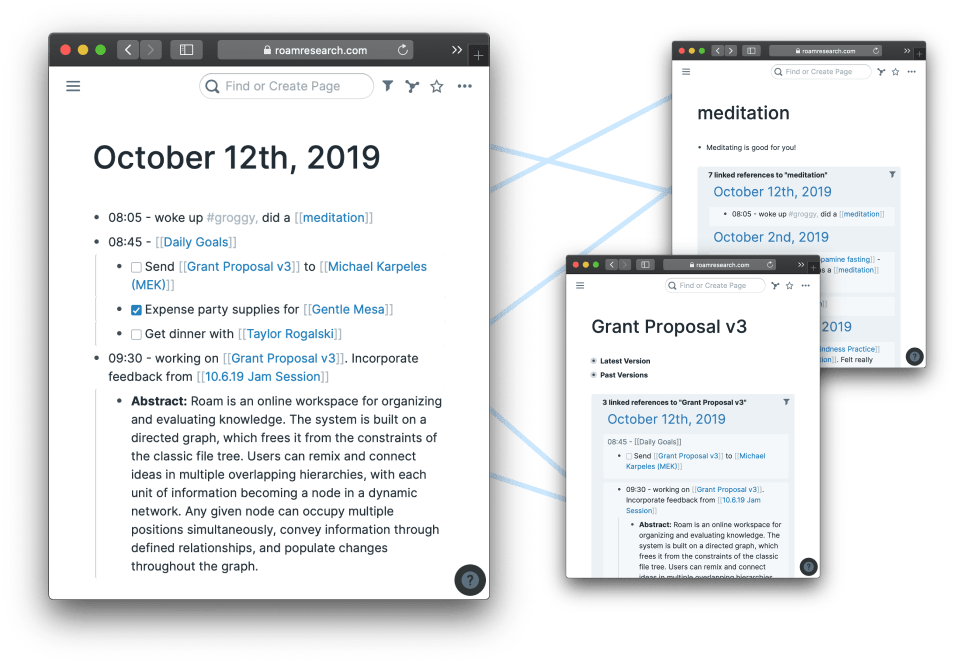
Roam had impressed me with two features that struck me as the biggest improvements to note-taking I had seen since Evernote materialized in 2008. (Evernote helped invent the ideas of ubiquitous note capture and cloud-based synchronization, two huge breakthroughs at the time.) The first is what Roam calls bidirectional linking — by putting any word or phrase in double brackets, you create a page for that link that gathers all mentions of it into a single note, along with a space for you to add additional information.
On the surface, I realize, that looks a lot like adding a hashtag to a document. In practice, though, I found myself using bidirectional links much differently than tags. In Roam, I created bidirectional links to concepts that I wanted to explore, like “the internet is too fast” or “social networks have been a boon to the conservative movement.” When I read something that made me think of that concept, I dropped a link on its dedicated page. And presto: My notes had suddenly become much less transient. My knowledge work was accreting.
The second feature that impressed me about Roam was the way that it enabled notes to organize themselves. Every previous app I used asked me to build elaborate hierarchies for notes, sorting them into various notebooks and hashtags, as if I had any idea where anything belonged. One of Roam’s breakthrough ideas is to present the user with a fresh, dated note each day, the way a journal does; each time you open the app, you see today’s date and a bullet point that encourages you to begin thinking out loud.
By designing itself this way, Roam has prompted me to journal more consistently than at any other point in my life. Each day, I sit down and quickly type out whatever is on my mind: work stuff, personal stuff, and even the day’s to-do’s. As I go, I add bidirectional links to the people, companies, and ideas that are important to me. And as a result, I now have a journal that is radically easy to search — if I want to pull up every thought I’ve jotted down about Facebook in the past year, or every time I saw my friend Brian, I can access it all with a single click. The notes have no hierarchy, and they don’t need one. The links organize the notes.
Of course, software can only take you so far. I still don’t write down most of the thoughts that I have, even on subjects I have written multiple columns about. Nor do I try to disstill these thoughts into sharp-edged little maxims the way Matuschak does in his own note-taking practice. He says he spends two hours a day refining notes he has previously taken into progressively truer versions of themselves; I would love to spend my retirement this way, but in the meantime I have a column to write.
And despite the breakthroughs Roam has made in rethinking note-taking, the software itself leaves a lot to be desired. Its bare-bones, brutalist design has all the charm of a command line. Enhancing its functionality often involves searching for some arcane bit of CSS written by a fellow Roam obsessive and inserting it as a code block in your daily journal — a nifty trick, but not my idea of a good time.
The bigger issue, though, is what I have come to think of as note-taking’s camera roll problem: no matter how well they organize themselves, most notes are still doomed to be forgotten. When it came to pictures, Timehop and later Google Photos addressed this problem by making an effort to resurface old photos in a variety of ways: on the anniversary of the date the photos were taken, for example; or as soon as it could round up a dozen or so great pictures of your dog or baby. In a world of finite photos, we put the good ones on our desks and revisited the rest in photo albums. In a world of infinite ones, though, we needed software to help us rediscover them.
Academia has invented a solution for this problem when it comes to learning; they call it spaced repetition. If you’ve ever used flash cards to study, you’ve employed this method. Some note-taking software will now show you a subset of your notes at regular intervals to help you jog your memory; a third-party plug-in for this is now available for Roam. To my mind, though, this needs a first-party solution: Roam should show me old concepts, ideas, and even people and places when I open it each day, and encourage me to do more of the refining and expanding that Matuschak so enjoys. The Google Photos of note-taking apps, I think, would be a monster company.
III.
Even in this early stage, though, Roam appears poised for outsized success. A couple weeks after I bought my five-year subscription, the company announced it had raised $9 million, valuing the company at $200 million while still in its seed stage. It already had $1 million recurring revenue and was profitable, CEO Conor White-Sullivan told The Information.
More telling, though, is how quickly Roam has been copied. It inspired a free alternative called Obsidian; and a more polished, venture-backed alternative called Mem.ai. Bidirectional links and a journal-like daily notes page both figure prominently in their designs; bidirectional links have also come to the fast-growing collaboration software company Notion.
All these apps are on to something; the question is who will be the first to finish building the vision. Right now, it feels like anyone’s game to win — and the competition, at least for this nerd, has been quite fun to watch.
Ultimately, I suspect I will always want more from note-taking software than it gives me — because what I truly want is for the software to read my mind. I want it to extract my thoughts automatically (and securely!) and polish them until they resemble wisdom. And I want it to resurface my ideas at calculated intervals, helping me make new connections and otherwise evolve my thinking.
It’s too big an ask, and I know I have set myself up for disappointment. But after a couple decades of professional note-taking, it now seems at least possible that there is a partial path to get there. My fingers are crossed: A tech platform that manages to improve the quality of our thinking would be very welcome indeed.
Governing
⭐ Turkey is the latest country to crack down on Google, part of a local trend of countries using antitrust laws to rein in the business practices of tech giants. The motivations are mixed — Turkey is an increasingly authoritarian state — but the global trend is clear. Here are Adam Satariano and Daisuke Wakabayashi in the New York Times:
Google has been a constant target. This month, French antitrust authorities fined Google 500 million euros, or $593 million, for failing to negotiate in good faith to reach a licensing deal with news publishers to use short blurbs from articles in search results. Last month, Indian competition authorities opened an investigation into claims that Google used its dominant position as owner of the Android mobile operating system to give itself an advantage in the smart-television market.
In May, Italy’s antitrust authorities fined Google €102 million for barring an electric vehicle services app from access to its Android in-car software system.
Related: Google has been sued in the United Kingdom for allegedly overcharging millions of customers. The complaint alleges that Google’s 30 percent take rate has artificially raised prices; a similar lawsuit was filed recently in the United States. (Ellen Milligan and Katharine Gemmell / Bloomberg)
A look at how automated systems increased censorship of Palestinian voices during the recent conflicts. A local rights group “says it logged a total of 668 digital rights violations, each of which it flagged to social media platforms, with more than 250 complaints relating to Instagram alone.” (Bani Sapra / Wired)
The CEOs of all the tech giants urged Congress to pass a law allowing people who were brought illegally to this country as children to become citizens. They have been banging this drum forever; the question is whether their lobbyists can achieve anything. (Jordan Fabian / Bloomberg)
Google is kicking so-called “sugar dating” apps out of the Play Store. It’s part of a broader crackdown on developers that also includes terminating inactive accounts and new policies related to ads and spam. (Jon Porter / The Verge)
Vaccine hesitancy stems more from top-down partisan cultural warfare than social media posts, this sharp piece argues. “Even if Facebook and YouTube could erase all anti-vaxx content from their platforms overnight, that would only take one bite out of a much larger problem.” Preach. (Gilad Edelman / Wired)
Industry
⭐ A profile of Sophie Zhang, a former Facebook employee who has criticized the company’s inattention to the abuse of its platform by foreign countries against their own citizens. Here’s Karen Hao at the MIT Tech Review:
On her last day, hours after she posted her memo internally, Facebook deleted it (though they later restored an edited version after widespread employee anger). A few hours later, an HR person called her, asking her to also remove a password-protected copy she had posted on her personal website. She tried to bargain: she would do so if they restored the internal version. The next day, instead, she received a notice from her hosting server that it had taken down her entire website after a complaint from Facebook. A few days after that, it took down her domain as well.
Facebook has sold 4 million Oculus Quest 2 headsets in the United States, documents related to its product recall show. It may have sold as many as 8 million units worldwide. (Janko Roettgers / Protocol)
Amazon fell short of investor expectations. On the plus side, though, it made $113 billion in revenue. (Annie Palmer / CNBC)
Pinterest fell short of investor expectations, too, showing a decline in monthly users. About 24 million people, or 5 percent of the total, stopped using Pinterest in the last quarter. (Salvador Rodriguez / CNBC)
Twitter is closing its San Francisco and New York offices just days after re-opening them, in response to changing COVID guidance from the Centers for Disease Control. The whiplash here has got to be hurting productivity at these companies, no? (Mary Ann Azevedo / TechCrunch)
LinkedIn will now let most employees work remotely permanently. The Microsoft-owned company previously said employees would have to come to the office at least half of the time. (Danielle Kaye / Reuters)
Former Googlers say that when they complained about mistreatment by their managers, they were offered mental health counseling. Seems bad! (Alisha Haridasani Gupta and Ruchika Tulshyan / New York Times)
Snap CEO Evan Spiegel has quietly donated $100 million in stock this year. The company declined to name the recipient. (Hayley Cuccinello / Insider)
American teens are making good money selling vintage clothes on Etsy-owned Depop. Every generation gets the eBay it deserves? (Alexandra Marvar / The Verge)
A look at the thriving stripper community on TikTok. “Instead of gathering around a water cooler, they have built an online network to exchange professional advice, safety tips and good old-fashioned strip club gossip.” (Madeleine Connors / New York Times)
Those good tweets


Talk to me
Send me tips, comments, questions, and Roam graphs: casey@platformer.news.
This is my kind of article. I am very interested in knowing how writers (like you) utilizes tools to be productive with work. Sort of behind-the-scene of how you roll. Let's make this a twice-or-four times a year post.
More like this please! 👍
I’m sure you’ve looked into it and don’t have any interest in switching after paying $500, but for anyone reading this I would strongly recommend Obsidian. They just launched a really killer mobile app, and the windowing and custom themes support are really nice. They also allow for community-generated plugins that can basically add on any kind of features you could imagine. It’s really, really sick.