
How Glass is challenging Instagram by going back in time
Can a throwback social network compete with a giant?

The Federal Trade Commission re-filed its lawsuit against Facebook today, as expected, alleging that the company had illegally built and maintained a monopoly using competition-crushing acquisitions and other anticompetitive tactics. To prove Facebook is a monopolist, the FTC added around 30 pages to its original filing, packed with new data points meant to bolster its argument. Unfortunately, the FTC redacted almost all of those data points, leaving us all basically in the dark as to whether they have meaningfully improved their case. Judge James E. Boasberg of the District Court of the District of Columbia, who threw out the lawsuit in June, will now decide whether it will proceed.
In the meantime, it felt like a good idea to talk about some of the competition that the FTC alleges does not exist.
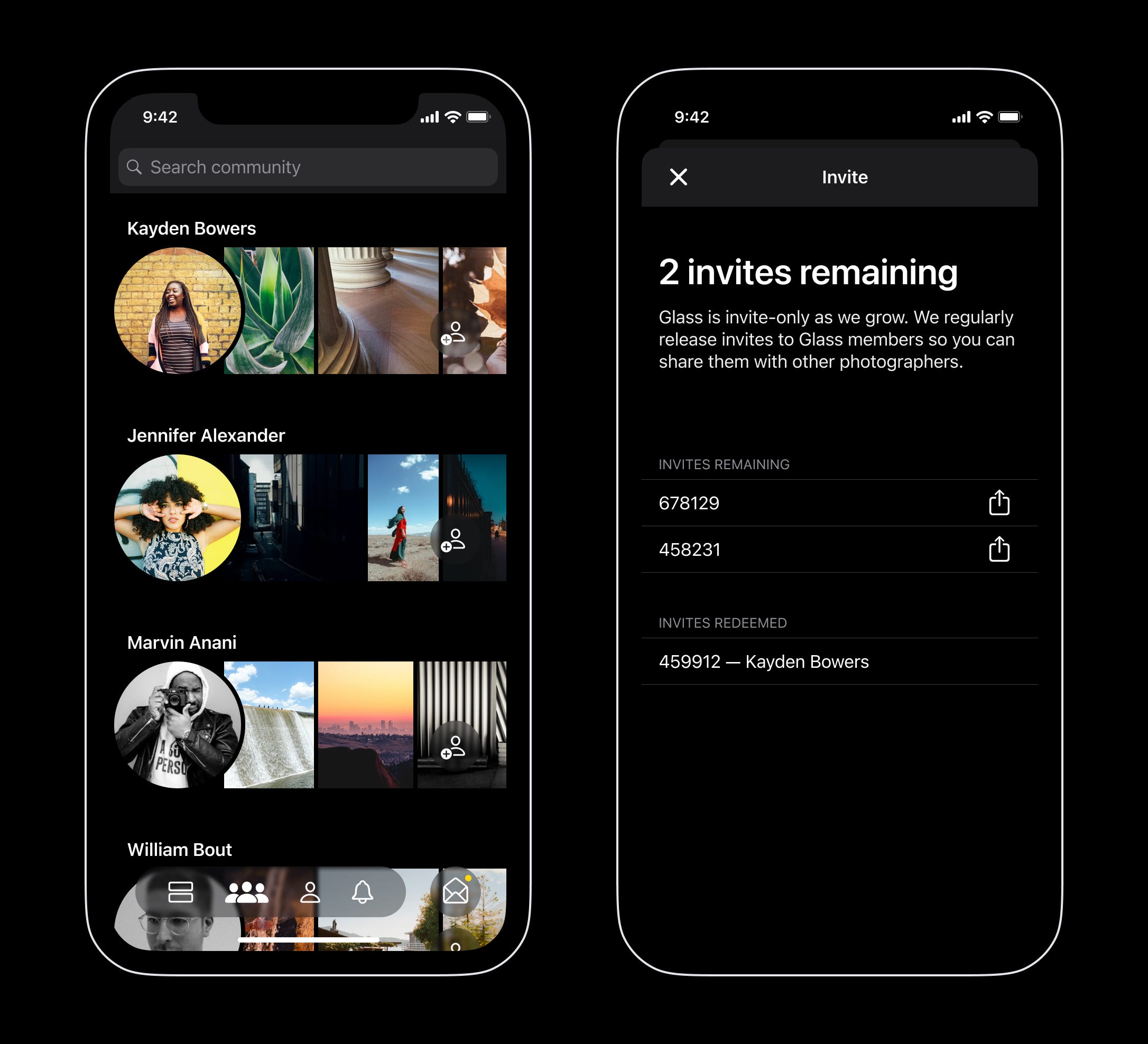
Tom Watson worked at Facebook from 2009 to 2013, where he helped design the company’s early mobile apps. Later, he spent four years at Pinterest, where I got to know him a bit as he launched that app’s messaging feature. For the past two years, Watson and his co-founder Stefan Borsje have been building Glass — a subscription social network for photographers. It’s now in a private beta; I’ve been testing it for the past couple weeks.
Viewed one way, Glass is a reaction to everything that people say they dislike about Facebook and Instagram these days. There’s a single, chronologically ordered feed. There are no public like counts. There is no explore page, no publishers, and no advertising. For $4.99 a month or $49.99 a year, you can get an app from an alternate universe in which Instagram is still deeply devoted to its community of photographers. (The contemporary twist is, of course, the subscription model.)
Glass has won early praise, with Daring Fireball’s John Gruber calling it “an absolutely lovely, exquisitely designed app.“ In a post this week, the founders said that thousands of people are now on the platform, and hundreds more are being invited each day.
Can the version of Instagram that people say they want compete with the Instagram that actually exists? It’s a steep climb, and one that Glass has only just begun. (It’s also bootstrapped; the founders are its only investors to date.)
But the tech industry moves faster than the FTC’s market definitions, and paid social services are popping up across an ever-broader range of industries. With that in mind, I talked to Watson about Glass’ business model, building a community, and whether it will ever pivot to video.
You’re about a week into your private beta. How’s it going so far? What have you noticed about the community?
It's going well! We're thrilled with the response. It was a lot more that we were anticipating. We've reprioritized our roadmap a bit and are now focusing on discovery features, specifically categories, in order to deal with the number of people joining the community. We wrote a little "Glimpse into Glass" about our first week and plans for the future.
In a way, a “photo sharing app” can feel like a throwback: there were dozens of them in the early 2010s, but after Facebook bought Instagram, they all started to fade away. So why Glass, and why now?
You're right that when Facebook bought Instagram it was a moment when they all started to fade away. Not long after, in 2013, is when I started designing concepts and talking to friends about what would eventually become Glass. It was probably too early back then, but I couldn't get the idea out of my head — photographers were missing (or were soon going to miss) actual community online. So, I just kept on plugging away and talking to possible collaborators on the project, and I am thankful I met Stefan to make it a reality.
I think it's a confluence of factors that make now a great time for Glass and other networks like it:
Photographers who helped build networks have felt abandoned by them as these networks shift focus towards more engaging content.
There has been a collective realization that the way social media companies operate might not be in the best interest of the people using those platforms.
People are more open to subscription models more so now than ever before on the internet. There has been a collective awakening of what "free" really means.
With AWS and App Store subscriptions, you can make something like Glass sustainable using a small team without outside investment.
These factors are why we believed now was a perfect time to start Glass.
There’s a common critique of social networks that says the problem is the business model. They optimize for time spent and engagement to juice ad impressions, and the result is a lot of outrage-bait and other borderline content designed to keep you scrolling. Do you share that view? And in practice, does a paid model really incentivize different kinds of posts?
Yes. We're seeing paid models pop up in all platforms. Newsletters, movies, video games, these all get to do things differently because of their business models. We think social networks, or online communities, do behave differently with different business models. We don't need to use an algorithmic feed to keep you engaged for longer to sell you advertisements. We don't track those things. We can ignore these metrics and just listen to our communities needs and build the best service for them.
Another way Glass differs from its peers is by rejecting the idea of a ranking algorithm: the feed is reverse-chronological, just like the Instagram of yore. What’s your case for ranking by recency?
Photography is personal and we trust our users with their feeds. It's also refreshing and clarifying to know why and when you're seeing something in your feed. It's crazy to me that this is novel now, but we've grown to expect algorithmic feeds from almost all social apps in 2021. It also makes the act of following someone mean what you think it does — knowing you'll see their posts. On other platforms following is more: show me some of this person's content sometimes, maybe, depending on what the algorithm wants and monetization efforts of the company are today.
You built blocking and reporting features while you were still in private beta — something every social network should do, but that many don’t. How does that play into your hopes for building a vibrant community?
We've got a long way to go to get to where we want to be, but equity and inclusion are the big reasons why we focused on them. We want people to feel safe on our platform from day one, and in order to do that we needed these tools. If you're from a marginalized group not having these tools makes you hesitant to participate — so we spent the time to build them early. Hopefully, these and other efforts we're making, like direct outreach to underrepresented photographers, will lead to a more diverse and vibrant photographer community.
One of the most interesting design choices you made in Glass was to keep photographers’ names and like counts off their photos as you scroll through the feed: unless you tap in, you see nothing but images. Why is that?
Your photography is the point, so we made your photos as much of the interface as we could. You can easily swipe to see who took the photograph, and it becomes fun to start guessing who took what photo as you see the visual voice of the photographers you follow. Counts aren't anywhere in the app. That is another intentional choice to help you focus on the community and the photography itself — not amassing followers or like counts.
Every photo app in history has expanded to include messaging and video eventually. Do you see Glass’ mission expanding similarly over time?
We're focusing on just the needs of this community right now, and without investors, we're able to do just that. We do not need to pivot and expand into other areas just to grow and be the next unicorn. We have no plans for expansion into any of those areas, but we'll be listening to our community and building for their needs. So, you never know. We know that whatever we do in the future, we can make different choices because of our business model and lack of outside investment.
I had one last question for Watson: with so much talk about competition in the air, does he feel like there’s a relatively level playing field? And are there things he’d like to see the government do to make this market more competitive?
He declined to comment.
Glass is now available on iOS.
The Ratio
Today in news that could affect public perception of the big tech companies.
⬇️ Trending down: OnlyFans, which all but invented the market for adult content subscriptions, announced it would walk away from the business almost entirely in October. While nude photos and videos will still be allowed, it feels like the beginning of the end for the platform — and will put many of its creators in a difficult position as they attempt to relocate their fan bases. Given how much money the company was making — $400 million in revenue a year! — the outcome is shocking. Lucas Shaw had the scoop at Bloomberg:
The changes are needed because of mounting pressure from banking partners and payment providers, according to the company. OnlyFans is trying to raise money from outside investors at a valuation of more than $1 billion. […]
The company has been praised for giving sex workers a safer place to do their jobs. But sex work still has a stigma. The company handled more than $2 billion in sales last year and is on pace to generate more than double that this year. It keeps 20% of that figure.
Governing
⭐ Brian Boland, a longtime former Facebook executive who oversaw its CrowdTangle research tool before leaving last year, criticized the company’s new quarterly report on “widely viewed content.” The data released is “generally useless,” he argues:
US Only — For a service that has the vast majority of its users outside of the US releasing a report focused on the US only is highly problematic. While the bottom of the press release says that they will add more countries in the future we really need to know where and when. At this time there is no additional visibility being brought to the rest of the world.
Significant subset of data — Since there is so much content on Facebook the top 20 (or even 100) of a list like this only produces a tiny sliver of a very specifically defined set of content. With the scale of Facebook there is a ton more content that will reach people and impact them that will never see this report. In fact, so much of what is shown in the posts here is meme content that may get significant reach but likely doesn’t have much impact.
A man suspected of making a bomb threat near the Library of Congress broadcast himself live on Facebook for hours before he was apprehended. His broadcasts totaled a cumulative 71 minutes before Facebook began to remove his accounts. (Emily Birnbaum / Politico)
Facebook outlined steps it is taking to protect users from the Taliban in Afghanistan. Among other things, the company has disabled the ability to search and view friends of users in the country. (Salvador Rodriguez / CNBC)
Facebook said it removed more than three dozen pages that were spreading vaccine misinformation, after the White House called on social media companies to do more to rein in bad actors. But it pushed back on a widely cited statistic that just 12 people are responsible for spreading most of the misinformation, saying there was no evidence for it. (Reuters) A breakdown of the most interesting emails from the Apple-Epic Games trial. Among other things, a fun history of anticompetitive behavior across the industry. (Sean Hollister / The Verge)
Municipalities are spending an average of $1 million per job to entice tech giants to build data centers in their cities. An investigation found that companies had received more than $800 million in tax breaks on the centers, whose economic contributions to city life aren’t always clear. (David Jeans / Forbes)
More Americans now say government should take steps to restrict false information online than they did in 2018. Pew Research reports that 48 percent of people say the government should move to limit the spread of misinformation, up from 39 percent three years ago. (Amy Mitchell and Mason Walker / Pew)
Tencent doubled the amount of money it is donating to social responsibility programs to $15 billion, under increasing pressure from the Chinese government. “The new funds will be focused areas like increasing incomes for the poor, improving medical assistance, promoting rural economic efficiency and subsidizing education programs.” (Zheping Huang / Bloomberg)
Industry
⭐ Facebook previewed Horizon Workrooms, its virtual-reality conference room simulator. Alex Heath at The Verge sat in on a virtual meeting with top executives including Mark Zuckerberg; the animated clips included here are really fun.
It’s the social network’s first stab at creating a VR experience specifically for people to work together in. After spending over an hour in Workrooms, I can see its potential as a more immersive way to communicate with people who are physically apart, but I don’t see it catching on beyond the most diehard VR enthusiasts anytime soon. That said, I can see this experience become compelling for more casual users, and potentially those who are totally new to VR, in the years ahead.
While an incremental update to Facebook’s VR efforts in its own right, Workrooms fits into the social network’s broader ambitions to own the next computing platform and build the so-called metaverse. Zuckerberg went so far as to recently say he wants Facebook to be primarily thought of as a metaverse company—a sci-fi concept that says we will all one day spend significant chunks of time in a fully immersive, digital space. Or as Zuckerberg puts it, an “embodied internet.”
Facebook is bringing Reels from Instagram to the News Feed and Groups. You’ll be able to create new Reels all over Facebook, as part of the company’s big push into short-form video to compete with TikTok. (Sarah Perez / TechCrunch)
Facebook signed 25 local journalists to multiyear deals in which they will write paid newsletters to cover their towns. The company set aside $5 million for the effort; here’s hoping it works. (Elizabeth Culliford / Reuters)
Related: Twitter is testing letting you sign up for newsletters via the profiles of people writing on Twitter-owned Revue. Any hope of a Substack integration here? (Ian Carlos Campbell / The Verge)
Amazon plans to open large retail locations akin to department stores. “The new retail spaces will be around 30,000 square feet, smaller than most department stores, which typically occupy about 100,000 square feet, and will offer items from top consumer brands.” (Sebastian Herrera, Esther Fung and Suzanne Kapner / Wall Street Journal)
Apple’s attempt at podcast subscriptions is off to a messy start. Podcasters say the spring has been marked by troublesome bugs and steep labor demands for back-end work that small teams find difficult to manage. (Ashley Carman / The Verge)
David Marcus wrote an update on Novi, Facebook’s cursed cryptocurrency project. It’s “ready” to come to market, he says, and has been approved for use in “nearly every state.” (David Marcus / Medium)
A controversial Twitch star known as Amouranth had her house catch fire in a suspected arson. Kaitlyn Siragusa is the most popular female streamer on Twitch; naturally, she is the target of constant death threats. (Nathan Grayson / Washington Post)
Those good tweets


Talk to me
Send me tips, comments, questions, and your Glass user name: casey@platformer.news.