
Apple has a Vision
Can a productivity-focused headset outflank Meta's metaverse?

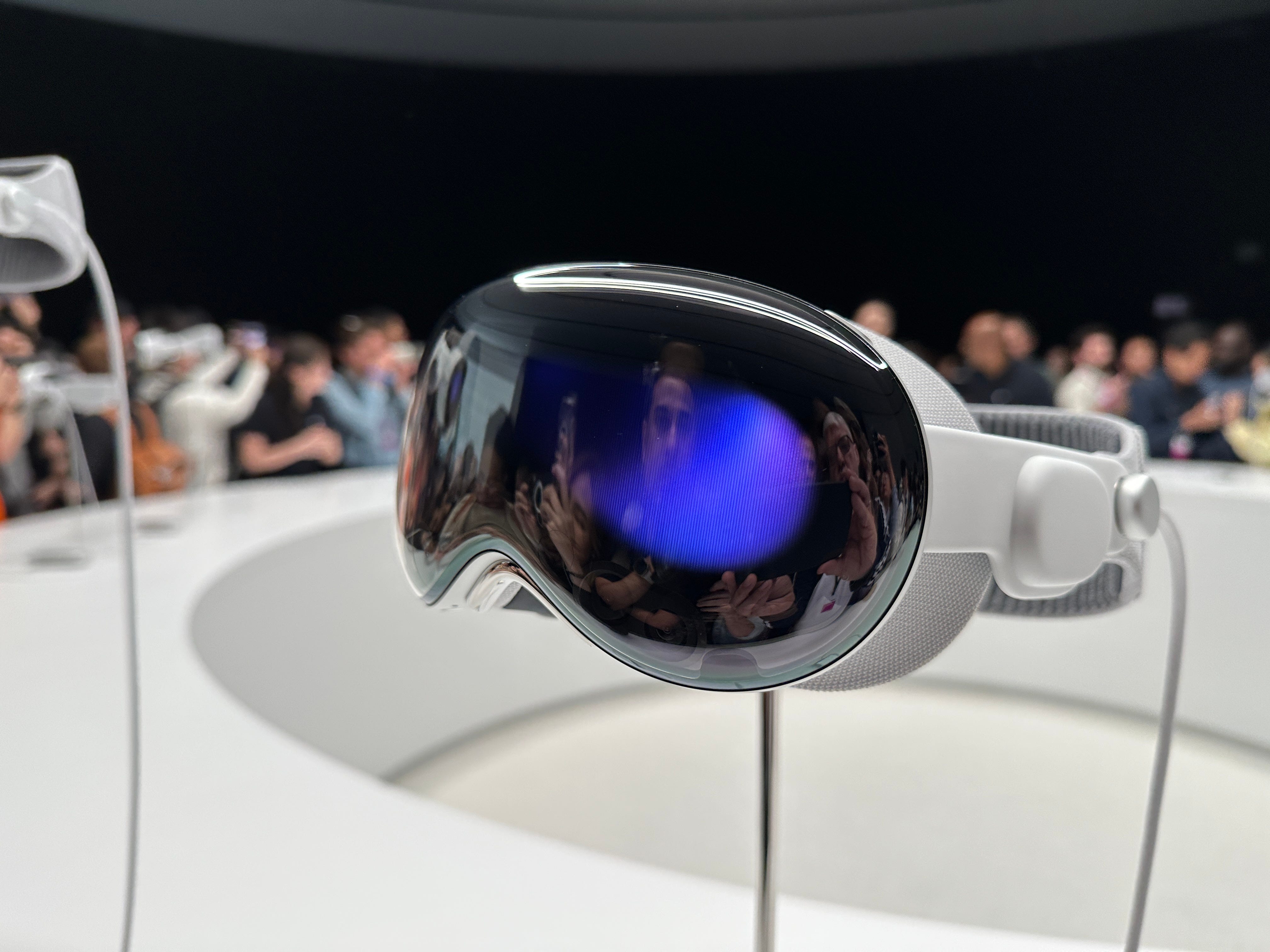
Last week, I wrote here that Monday would be the wrong day to judge Apple’s new augmented reality headset. The technology is simply too nascent, and its limitations too apparent, to draw firm conclusions about the device’s long-term prospects.
After watching Apple’s keynote today for the Worldwide Developer Conference, I still feel that way. At the same time, I don’t want to let uncertainty about the long-term future of AR and VR overshadow the fact that the Vision Pro looks to be a remarkable piece of hardware. Pending the overcoming of some significant challenges, it could be the kind of thing that inspires a true platform shift.
The first thing to reiterate, though, is that it will be a long time before we find out. The Vision Pro — not the Reality Pro, as Bloomberg had predicted — won’t come out until “early next year.” When it does, it will start at an eye-watering $3,499, a price tag that makes the Meta Quest Pro look like a bargain at $999.
At that price, the Vision Pro flies out of reach of all but the wealthiest consumers and most indulgent businesses. It also gives the device an aspirational sheen, though, in the finest tradition of Apple over-pricing its goods. And it seems likely, at least at first, to draw consumers in by the thousands to see it at Apple’s retail stores, where they can pick up a $40 MagSafe charger or $60 iPhone case while they wait in line.
Given that I won’t be able to try the device for months, one of my main questions heading into today was how Apple would position the device. Would the Vision Pro be presented as a developer prototype, the Magic Leap has sometimes done? Or would Tim Cook describe the device more casually, as a “hobby,” the way his company long described Apple TV?
The answer turned out to be neither: this company is swinging for the fences. Cook introduced the Vision Pro as “a revolutionary new product” that heralds the arrival of what he called “spatial computing” — the next major shift in consumer technology following the mobile computing era that Apple kicked off with the iPhone. In doing so, I think, Cook staked a significant portion of his own legacy on the degree to which that proves to be true. And it’s hard to imagine him doing so were he not supremely confident in the rapid evolution of augmented reality.
More than anything else, I think, Apple’s Vision Pro presentation was defined by its seriousness. Where’s Meta’s Quest keynotes have been dominated by gaming, cartoon characters, and a general sense of escapism, Apple positioned the Vision Pro as the office of the future. You can connect it to your Mac laptop just by looking at it through the device’s goggles; when you do, a giant virtual screen appears above the computer, letting you work on a canvas as big as your field of vision.
Or take EyeSight. It’s a Vision Pro feature that creates a virtual representation of your eyes and projects them on the front of the device, to signal to any nearby humans whether you can see them or not. While the feature will no doubt be useful in households, it also strikes me as the sort of thing that will be essential in offices — a way to tell at a glance whether the coworkers you’re standing in front of can actually see you.
Apple did talk up the device’s potential for fun — particularly in watching videos on those impressive twin 4K displays and accompanying spatial audio. It also gestured at the device’s ability to play games.
But where Meta’s Quest line has turned out to be, first and foremost, a gaming console, Apple mostly kept gaming out of sight. That seems smart, given the Vision Pro’s lack of controllers, and Apple’s historic weakness in triple-A gaming. If you have $3,500 to spend on playing video games, you can build a much better PC gaming rig than the Vision Pro is designed to be.
If it’s to be more than a device for entertainment, though, it has to deliver a productivity experience that is radically better than the one we can get today with our desktops and laptops. And that’s where much of this prospective future has yet to be invented.
Meta tried this approach with the Quest Pro, too, and hasn’t yet been able to make many inroads. In my own tests with that device, the idea of working on a giant virtual display, however appealing in theory, in practice has been uncomfortable. The bulky headset, limited battery life, and relatively muddy displays have made working in AR or VR something I would do only in case of emergency.
As Apple’s FaceTime service improves, I can see — in theory — eventually coming to prefer AR-based calls over Zoom. But it feels like for the Vision Pro to really work, it has to be radically better than your current office setup at almost everything. Otherwise, the laptop remains the default.
And let’s face it: most modern office work gets done in a web browser. One of the toughest unanswered questions here is what makes a $3,500 computer better for running Chrome or Safari than the computer you already have.
There are two reasons I think Apple or a rival may yet figure that out, though. One is that I expect virtual displays to steadily improve. Eventually, I think, it seems obvious that you’ll be able to find a better display in AR or VR than you can on the shelves at Best Buy. Maybe it’s better because it’s bigger than the physical monitors you can afford. Maybe it’s better because you can port it all around your house, and position it however you like. Maybe it’s better because it fits in your bag when you travel.
Whatever it is, I think Apple or someone else can make that happen.
The second reason is that I believe, in my heart, that consumers want heads-up displays like the ones we have seen for so long now in science fiction. We’ve already come up with so many ways to let friends, family, and apps chirp at us all day — notifications on the phone, notifications on the watch, notifications on the desktop. So much of modern life is just trying to locate the source of the thing that’s beeping at you in an effort to tell you something.
Vision Pro could represent the end to all that glancing around. When you’re wearing it, notifications come directly into your field of vision, without interrupting what you’re already doing. So many people I know already stare at their phones so much I’m convinced they would attach them to their faces if they could. Vision Pro will offer them a chance to live in a world — for better and for worse — where that’s a reality.
Of course, when the Vision Pro does arrive, the compromises will be obvious. There’s that unfortunate cord coming out of the back, leading to a chunky battery pack. There’s the limited battery life. There are real questions about how smoothly you can navigate the Vision Pro using just your hands and Siri.
There also does not seem to be a killer app, at least not yet. I thought the third-party demos Monday were the weakest part of the Vision Pro presentation. Looking at virtual constellations? Watching Disney+? Surely there are more creative uses for this thing.
Then again, that’s the point of unveiling the device at a developer conference. Developers now have the rest of the year to build out new experiences in the Vision Pro, and while the initial user base will no doubt be small, the prospect of staking out ground on a new computing platform will likely be alluring.
Tech reporters seemed mostly to shrug off the Vision Pro. On Twitter, I saw the usual rush to tweet a photo of the new thing captioned with “LMAO” just to see how many likes it would get.
But entrepreneurs I follow seem much more excited.
“Apple is going to have a hit with Vision Pro. All movies, gaming, workplace collaboration, industrial use cases, extension of a Mac, and basically every Apple ecosystem developer instantly working on the platform overnight,” Box CEO Aaron Levie tweeted.
Among Meta executives, I’m told, there was a sense of relief in seeing the Vision Pro unveiled. The high price, long period before shipping, and inattention to gaming give Meta an opportunity to build out its own vision of the metaverse without too much near-term competition.
Apple’s main job today was to lay out a compelling future of computing, make that future feel inevitable, and position its the Vision Pro as a groundbreaking step toward that reality. On that front, I think, it was a success.
The hardest work, of course, is still to be done. Little by little, though, the future is starting to come into focus. As soon as I can try out a Vision Pro, I will.
Talk about this edition with us in Discord: This link will get you in for the next week.
Pushback
Thanks to all of you for pointing out a typo in Thursday’s edition that said “queen men” instead of “queer men.”
After much thought, I decided to leave the typo up because it was funny.
WWDC 2023
Even aside from the Vision Pro, an unusually compelling and newsy Worldwide Developer Conference from Apple.
Apple’s new Vision Pro headset is positioned primarily as an augmented reality device, looks like a pair of ski goggles and will cost $3,499 at launch in the U.S. early next year. (Adi Robertson / The Verge)
The operating system powering Vision Pro is called visionOS, and Apple says it’s built from the ground up for so-called spatial computing. (Jay Peters / The Verge)
Apple’s new Optic ID is a biometric iris scan that will authenticate Vision Pro users. Apple claims the system is more secure than Face ID and can distinguish between twins. (Wesley Hilliard / AppleInsider)
Vision Pro contains an Apple M2 chip; the all-new R1 chip for processing real-time surroundings and reducing motion sickness; and 12 cameras, five sensors and six microphones. (Romain Dillet / TechCrunch)
Vision Pro will launch with support for more than 100 Apple Arcade titles playable on a virtual screen, but Apple did not announce any native AR or VR titles for the device. (Ash Parrish / The Verge)
Apple’s iOS 17 launches this fall with improved AI-powered autocorrect, a new AI-assisted journaling app, new Standby mode for landscape app view, FaceTime voicemail support. I think the journaling app might be the sleeper hit of this bunch. (Zac Hall / 9to5Mac)
The latest version of Apple’s desktop operating system is called macOS Sonoma, and features desktop widgets, a dedicated game mode, and new Safari features. (Brian Heater / TechCrunch)
Apple’s watchOS 10 adds a revamped widgets feature and improvements to the Compass, Mindfulness and Maps apps. (Sarah Perez / TechCrunch)
Apple updated its M2 MacBook Air with a 15-inch model that starts at $1,299. (Monica Chin / The Verge)
The new M2 Ultra chip is available only inside the refreshed Mac Pro, the first overhaul to the desktop machine in four years. Pricing starts at… $6,999. The cost of two Vision Pros! (Tom Warren / The Verge)
Apple announced two new AirPods features — Adaptive Audio and Conversation Awareness — to improve noise cancellation and speech detection, and both will be available this fall via software update. (Chris Welch / The Verge)
Apple’s new Sensitive Content Warning will warn iPhone users about a potentially harmful photo or video, seemingly with the express purpose of filtering out unwanted nudes. (Amanda Silberling / TechCrunch)
Governing
The U.S. SEC accused Binance of running an illegal securities exchange and mishandling consumer funds in a sweeping lawsuit that could remake the entire crypto industry. (Matthew Goldstein, Emily Flitter and David Yaffe-Bellany / The New York Times)
and Ryan Tracy / Wall Street Journal)
A deepfake of Russian President Vladimir Putin declaring martial law was broadcast over some television and radio channels in what the Kremlin is saying was a hack. (Jenna Moon / Semafor)
Marietje Schaake of the Stanford University’s Cyber Policy Centes argued that tech executives and in particular AI leaders should not be in trusted to guide regulation of the technology. (Marietje Schaake / Financial Times)
Stack Overflow moderators said they would go on strike to protest the platform’s new and more relaxed moderation policy on AI-generated submissions. Moderators said AI content “poses a major threat to the integrity and trustworthiness of the platform.” (Kevin Hurler / Gizmodo)
Montana’s TikTok ban threatens the income of the state’s growing creator community, some of whom make thousands of dollars per month and are considering relocating. (Lisa Bonos / The Washington Post)
Twitter let dozens of known images of child sexual abuse slip through its filters over the past few months in what researchers say is a glaring failure of basic content moderation. The images were part of shared databases platforms use and should have been caught, researchers said. (Alexa Corse / WSJ)
Instagram lifted its ban on Robert F. Kennedy Jr. over spreading medical misinformation after the anti-vaxx activist launched his presidential bid. Between this and YouTube’s decision to stop removing 2020 election lies, it’s been a grim few days for tech policy. (Cristiano Lima / The Washington Post)
The first detailed confession from a participant in India’s hacking-for-hire market is helping expose the country’s vast and interconnected cyberattack industry led firms like BellTroX. (David D. Kirkpatrick / The New Yorker)
News app Artifact will now use AI to rewrite the headlines of articles that are labeled and then verified to be clickbait. I love this. (Ivan Mehta / TechCrunch)
An examination of Bluesky’s status as a for-profit Public Benefit Corporation underscores the tricky balancing act CEO Jay Graber and her team must maintain to avoid the influence of wealthy backers. (Micah Lee / The Intercept)
Industry
Stable Diffusion founder Emad Mostaque has a history of exaggerating and mischaracterizing elements of his resume and business success, according to this report, and has taken credit for other people’s work. (Kenrick Cai & Iain Martin / Forbes)
Copywriters, content marketers, and social media professionals say ChatGPT has already automated their jobs away because of the cost-saving benefits of language models. (Pranshu Verma and Gerrit De Vynck / The Washington Post)
Healthcare provider Carbon Health is using GPT-4 to power a new medical records product that combines audio recordings and patient information to generate visit summaries. (Ilena Peng / Bloomberg)
Google’s Search Generative Experience, the experimental new search box powered by generative AI, is painfully slow and cluttered when compared to traditional search results. (Jay Peters / The Verge)
Scientists used AI to analyze a database of primate DNA to make more accurate predictions about genetic mutations that can cause disease in human beings. (Clive Cookson / Financial Times)
Professor David J. Malan, who teaches Harvard’s world-famous introductory computer science course, will start using AI to grade assignments and personalize lessons. Malan said it’s become difficult to teach the tens of thousands of students who tune into the course online. (Saritha Rai / Bloomberg)
Meta’s own employees are rarely using its Quest headset for videoconferencing and other work functions, despite the company’s pitch that such devices can be useful beyond gaming. (Aisha Counts / Bloomberg)
Spotify is laying off roughly 200 people, or roughly 2% of its workforce, from its podcasting division as part of a corporate reorganization. (Sahar Elhabashi / Spotify)
Twitter’s U.S. ad sales plunged to $88 million in April, a 59% year-over-year decline, as Elon Musk continues to alienate advertisers. This is why I continue to take those occasional grunts from Musk that Twitter is “roughly break even” with several helpings of salt. (Ryan Mac and Tiffany Hsu / The New York Times)
Mark Zuckerberg is spending more of his free time performing endurance training exercises and martial arts, and the executive competed in his first Brazilian jujitsu event last month. An event referee said he thought Zuckerberg had lost consciousness during of his fights, but Zuckerberg and his coach denied it. (Joseph Bernstein / The New York Times)
Major subreddits like r/videos and r/reactiongifs plan to set themselves to private on June 12th in protest of Reddit’s decision to charge third-party apps steep prices for API access. (Jon Porter / The Verge)
Microsoft expanded the Discord and Reddit-like communities feature of Teams to all free users alongside its new AI art tool Designer. (Tom Warren / The Verge)
Those good tweets
For more good tweets every day, follow Casey’s Instagram stories.
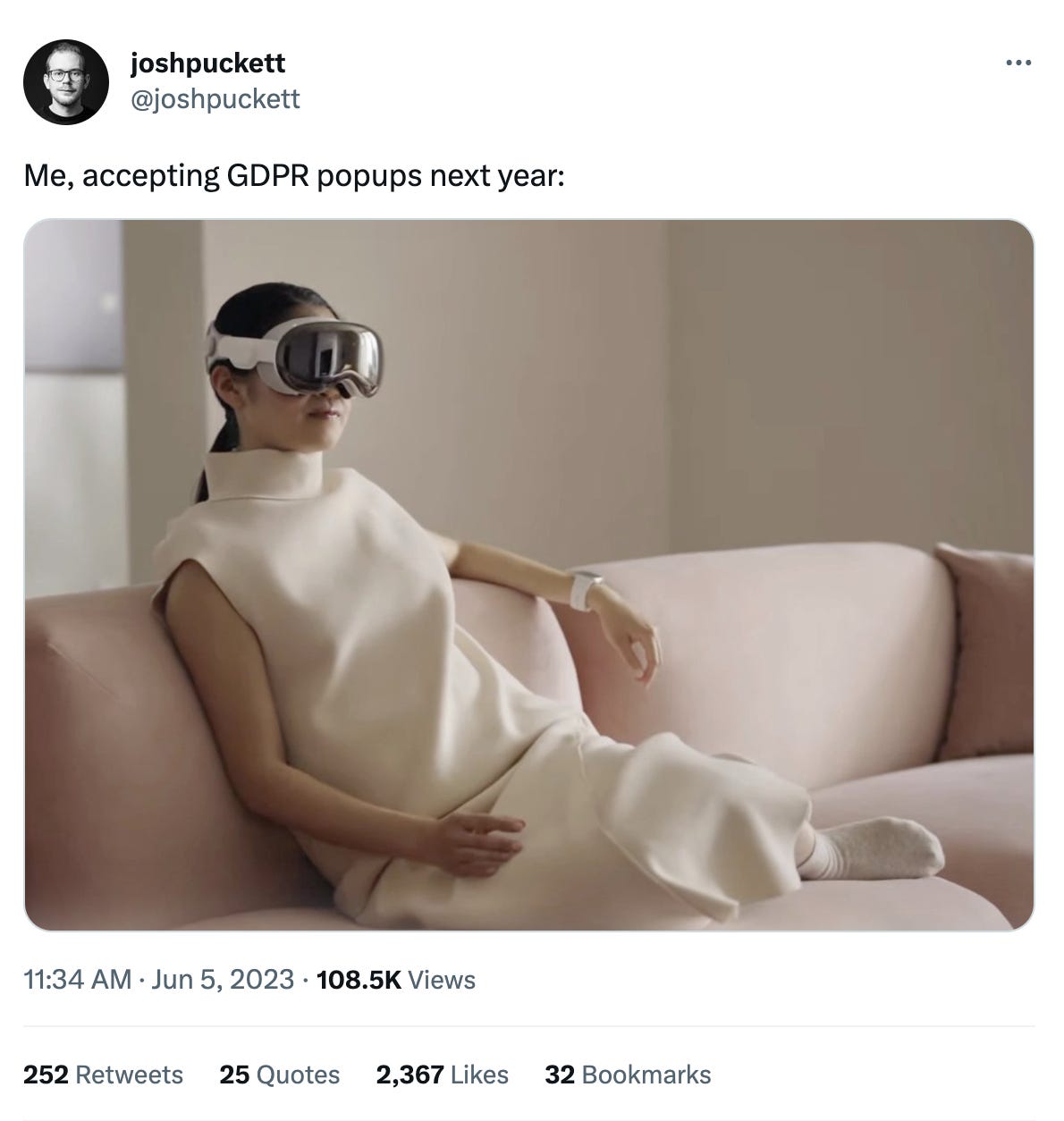
(Link)
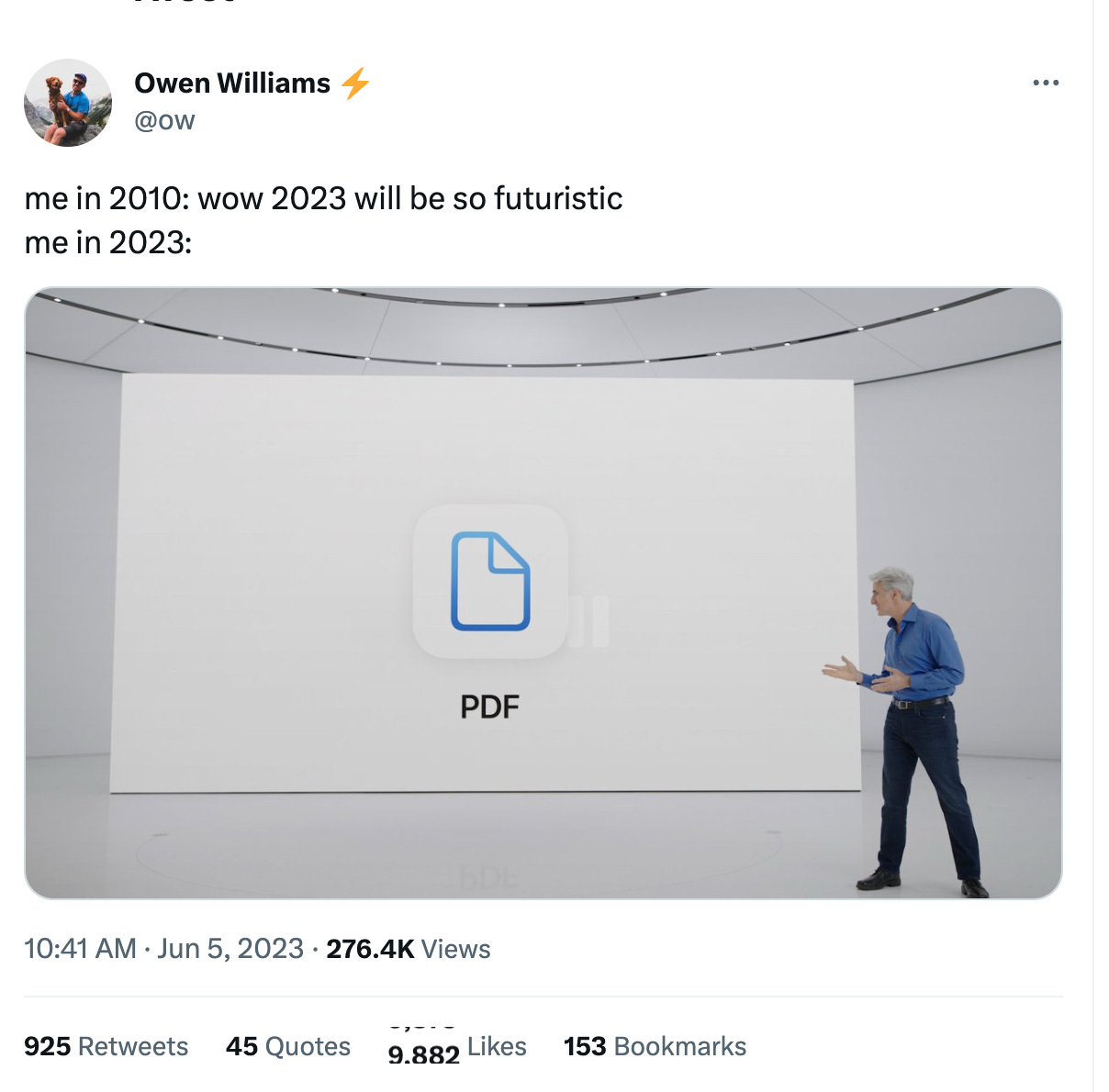
(Link)
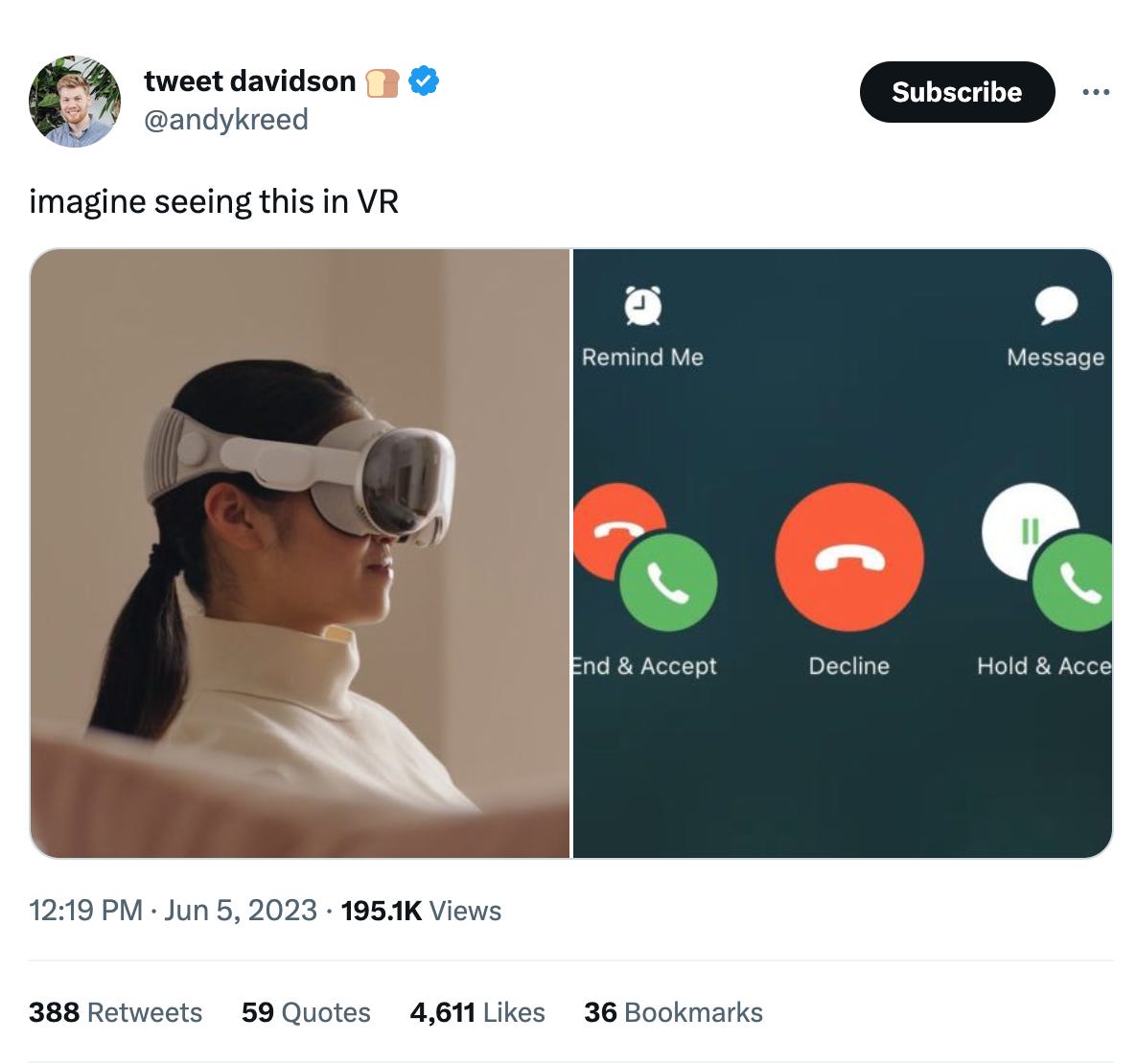
(Link)
Talk to us
Send us tips, comments, questions, and a Vision Pro: casey@platformer.news and zoe@platformer.news.
At first glance, I agree with Reddit's take on Apollo. Their bill is staggering but the math doesn't add up. I don't want to be too antagonistic or holier-than-thou. However I feel Apollo and other products dependent on Reddit's API could use some engineering rigor. Specifically, metrics to track Reddit API calls broken down by parts of their code could provide easy wins.
I'm fully aware that lots of developers hate the concept of thinking about cost control or resources usage. But thinking about those things, like thinking about product management, is how most developers mature. Just like every other engineering practice.
As a fellow queen man, I stand by your decision to not correct the typo.